Sudanese Displacement in Egypt: Survival Strategies and Urban Integration
Sudanese displacement in Egypt has emerged as one of the most pressing humanitarian outcomes of the ongoing conflict in Sudan. As war reshapes the physical and social landscapes of the country, thousands of Sudanese have sought refuge in neighboring Egypt. This article explores in depth how Sudanese refugees and displaced persons are navigating this uncertain terrain, focusing on their survival strategies, socio-economic adaptation, and the dynamic networks they form in their new environment.
1. The Sudan Conflict and the New Wave of Displacement
The Sudan conflict, reignited in 2023, has led to an unprecedented wave of displacement, with Cairo and other Egyptian cities becoming key destinations for those fleeing violence. Unlike previous migrations, this wave is marked by high levels of urgency, lack of planning, and severe trauma. The collapse of basic infrastructure and administrative services in Sudan has made Egypt not only a refuge but also a gateway to reimagining future identities. Displaced Sudanese in Egypt have been forced to rebuild their lives from scratch, often in precarious conditions.
Urban areas like Cairo have experienced a sharp rise in Sudanese populations, many of whom arrive with limited resources, no formal housing, and a deep sense of uncertainty. The Egyptian government’s inconsistent asylum policies, coupled with international inattention, have left refugees largely to their own devices. However, this has also given rise to an impressive array of survival strategies by Sudanese refugees.
2. Informal Economies and Everyday Survival
One of the most prominent responses among Sudanese displaced in Egypt has been their integration into Cairo’s vast informal economy. Refugees have found work as domestic workers, street vendors, security guards, or even as part of small-scale entrepreneurial ventures. Women, in particular, have created micro-networks of survival through food preparation, childcare, and artisanal work.
Children are often pulled into labor markets, either through necessity or lack of educational access. Educational institutions remain largely inaccessible to Sudanese refugees due to bureaucratic hurdles, language barriers, and costs. These limitations have created a generational gap, where younger Sudanese find themselves excluded from both the Egyptian education system and their Sudanese heritage.
3. Community Networks and Solidarity Mechanisms
Despite significant institutional neglect, Sudanese refugee communities in Egypt have shown remarkable cohesion and self-organization. Faith-based networks, diaspora associations, and neighborhood solidarity groups have emerged as the backbone of survival. These grassroots structures function as informal safety nets, providing housing, food, job referrals, and emotional support.
Mutual aid and collective caregiving are not just acts of kindness but are now institutionalized forms of resilience. A Sudanese single mother in Giza may rely on a WhatsApp group to find shared accommodation, childcare, or even a second-hand washing machine. These systems show the strength of a community determined to survive, despite legal and social invisibility.
4. Legal Status and Administrative Limbo
Legal ambiguity is a defining feature of life for Sudanese displaced persons in Egypt. While some are registered with UNHCR, many operate outside formal protection frameworks. Asylum processes are slow, lack transparency, and often fail to provide tangible benefits. Moreover, the ambiguous relationship between Sudan and Egypt — historically rooted in shared borders and colonial entanglements — complicates refugee recognition and integration.
Without legal status, Sudanese refugees cannot access formal employment, public healthcare, or even safe housing. This administrative limbo reinforces cycles of poverty and marginalization, pushing refugees further into the peripheries of urban life.
5. Identity, Memory, and the Politics of Belonging
Beyond material survival, Sudanese displacement in Egypt raises deeper questions of identity and belonging. Many displaced individuals struggle with the dual burdens of trauma and cultural alienation. For those from Darfur, Blue Nile, and Nuba Mountains, marginalization is not new. Yet displacement intensifies these experiences, stripping people of the few certainties they once held.
Some respond by forming tightly-knit ethnic enclaves, reinforcing old identities and customs. Others attempt to integrate into Egyptian society, adopting Arabic dialects or local customs. The result is a complex negotiation of identity, where survival becomes not just a question of food and shelter, but also of narrative and recognition.
6. Gendered Dimensions of Displacement
Women and girls bear the brunt of Sudanese displacement in Egypt. From exposure to gender-based violence during transit to vulnerabilities in host communities, their experiences are distinctly gendered. Many women head households alone, having lost partners to war or separation. This not only places a heavy economic burden on them but also alters gender dynamics within the household and the community.
Programs targeting refugee women remain scarce and underfunded. Still, Sudanese women have demonstrated strong agency by building support networks, engaging in income-generating activities, and asserting leadership roles in refugee advocacy efforts. Their stories are not just about survival — they are about transformation and leadership under fire.
7. Imagining the Future: Return, Resettlement, or Reinvention?
For many Sudanese refugees in Egypt, the future is a foggy landscape of conflicting hopes and limited options. The dream of return is tempered by the persistent instability in Sudan. Resettlement to Western countries remains a remote possibility, given current geopolitical climates and restrictive immigration policies.
As a result, reinvention has become the only viable path. Sudanese in Egypt are investing in long-term integration strategies, learning local trades, and building intergenerational support structures. The notion of “home” is increasingly being redefined — no longer a geographical place, but a network of people and practices carried across borders.
8. Policy Recommendations and the Need for Recognition
While this article has highlighted the resourcefulness of Sudanese refugees, their survival strategies should not absolve governments or international bodies of their responsibilities. There is an urgent need for more inclusive refugee policies in Egypt that acknowledge the unique challenges faced by Sudanese communities.
We recommend the following:
- Streamlining asylum processes and ensuring transparency
- Recognizing Sudanese displaced as refugees with full rights
- Supporting community-based organizations with funding and legal recognition
- Ensuring educational access for Sudanese children and youth
- Targeting gender-specific vulnerabilities with protective services
International bodies like UNHCR and IOM must expand their support frameworks to include not only protection but also social integration strategies that center Sudanese voices and leadership.
9. Conclusion: Resilience Amidst Neglect
The case of Sudanese displacement in Egypt is not just a humanitarian story but a political one. It speaks to the failure of states and international institutions to respond to one of the most severe refugee crises of the decade. Yet within this void, displaced Sudanese have created intricate systems of survival, care, and resistance.
Their efforts deserve visibility, support, and structural change. By centering their experiences, we not only honor their resilience but also challenge the frameworks that render them invisible. Ultimately, this is a story of survival — but it must become a story of justice.
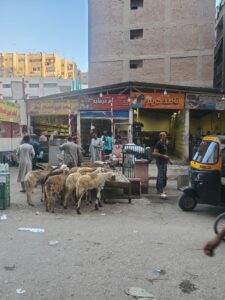
Various economic activities recorded in Faysal by the authors of this article.
Since the outbreak of the war in Sudan on April 15, 2023, over 1.2 million Sudanese fled to Egypt. They join approximately 4 million already residing there. This large presence can be attributed both to the geographical proximity of the two countries and to their longstanding historical ties. Over the years, relations between Egypt and Sudan have shifted between periods of close governmental alignment and episodes of tension, affecting cross-border mobility and the treatment of Sudanese in Egypt. Eventually, in 2004, the Four Freedoms Agreement was established, guaranteeing freedom of movement, residence, work, and property ownership for citizens of both countries. Following the outbreak of the conflict in Sudan, however, the situation deteriorated dramatically. Egypt gradually tightened entry requirements, which complicated residency procedures and introduced new obstacles for Sudanese seeking to register new businesses. Moreover, the newly arriving Sudanese find themselves in a stringent environment marked by excessive controls on their daily life practices and livelihoods. The economic crises and inflation they left behind, coupled with the collapse of the banking system and the devaluation of the Sudanese pound against the Egyptian pound due to the war, have placed a further strain on their financial capacities.
Once in Egypt, most Sudanese settled in Cairo and Alexandria. In Cairo, although they dispersed across several neighbourhoods, Faysal – a central neighbourhood situated on the west bank of the Nile opposite the city centre, part of Giza governorate – witnessed a particularly large influx of Sudanese following the recent outbreak of war. This increase was largely due to the presence of an established Sudanese community prior to the conflict, the ease of renting apartments owned by Sudanese landlords, and the affordable rents. However, the increase in demand for housing has since the war pushed up rental prices. Faysal is characterized by its social diversity, central location and diverse migrant community, mainly Sudanese, Yemenis, and Syrians. Among these new arrivals, some have established businesses such as restaurants, cafés, grocery shops, and beauty salons, while others have managed to set themselves as brokers mediating between these business as means of income. Due to the high concentration of Sudanese residents and shops in Faysal, many describe the area as evoking a strong sense of “being in Sudan”. The area’s significance in the Sudanese popular imagination has grown so much that Faysal appears in Zanig[1] songs and is mentioned by the Sudanese diaspora in Europe when discussing Cairo.
This piece explores how the recently displaced Sudanese in Faysal navigate the realities of displacement and the uncertain environment in which they find themselves. Through an overview of their livelihood practices in a highly volatile context, the piece contributes to the global debate on displacement survivalist strategies.
Informality: chameleon attitudes in a hostile environment
Numerous Sudanese run businesses have emerged in Faysal, primarily attracting Sudanese customers. These shops, often small (employing no more than two or three workers) and family-run, offer Sudanese products such as spices, oils, cosmetics, food items, household utensils and incense (bakhour) while some also provide beauty-care services. Most of these businesses function informally, operating outside the tax system. This status serves the business in an otherwise restrictive environment. It also allows business owners to operate in accordance with market environment of Egypt as well as of the displaced communities while remaining low-profile. Egypt’s informal economy is widespread, accounting for approximately 40% of GDP and between 45% and 70% of jobs and is particularly prevalent in neighbourhoods such as Faysal.
Since the onset of the war in Sudan, regulations concerning entry, residency, investment and economic activities have changed rapidly. For a restricted Sudanese community, registering a business now poses serious hurdles. The process increases in complexity as time passes. For example, one such hurdle is that entrepreneurs must deposit a sizeable sum into a designated bank account and obtain a security check.[2] Indeed, Sudanese recognized as refugees by the UNHCR are excluded from the banking system. In the context of war, the extreme tightening of Egypt’s entry requirements has forced many Sudanese to cross the border illegally via desert routes, compelling them to apply for refugee status upon arrival or remain as irregular for extended periods. Even those who hold visas to be renewed every few months – mainly those who arrived in the first weeks of the war, when it was still possible to obtain an entry visa – find it exceedingly challenging to open bank accounts. Moreover, these rules have changed multiple times in the past two years and often in an opaque way, making it very difficult for a struggling community to adapt. Finally, strict controls and restrictions on both the amount of money transferred into bank accounts (for those who manage to open one), and on cash brought into Egypt have driven many Sudanese not to try to open a bank account and move into the informal sector.
The informality of these businesses and the precarious administrative status of Sudanese in Egypt reinforce their vulnerability, exposing them to sudden shop closures, demands for bribes, or even the risk of expulsion from the host country.
Transnational capital networks
The challenging environment in Egypt compounded by the ongoing war in Sudan compels many displaced Sudanese to rely on primary solidarity networks for survival. As the war period prolonged, the funding of small-scale economic activities became the preferred model of support instead of handouts. In Egypt, “Baladi market’’, which is shorthand for lower-class micro- and small-scale enterprises,[3] lacks access to essential inputs such as bank credit. Stringent state regulations make it extremely difficult for those without significant financial or political capital to access funding. While some community-based organizations (CBOs), in partnership with UNHCR, provide help for refugees to start a business by offering training workshops and small grants, these amounts are typically quite modest[4] and awareness of such programmes remains limited among recent displaced Sudanese. In this context, the strong family ties that characterize Sudanese society, as well as the solidarity forged through neighbourhoods, local communities, ethnic affiliations, and the nafeer system نفیر, a cultural tradition mobilizing collective emergency responses, become an even more vital sources of support for displaced Sudanese.
Against this backdrop, the role of the Sudanese diaspora – especially in Gulf countries, the United States, and Europe – has grown significantly. The war has impoverished many Sudanese, forcing them to leave behind or lose a substantial portion of their assets during displacement. Additionally, the ongoing devaluation of Sudanese currency since the start of the conflict has further reduced their resources, compelling them to seek alternative financial avenues, notably from diaspora relatives.
Pre-war networks are also an important resource for displaced Sudanese. Businessmen who had established cross-border commercial activities before the war (notably between Sudan, Egypt and Chad) were able, after the war, to draw on these networks and knowledge to import products from Sudan or Chad to stock their shops in Egypt. These networks are also crucial for securing housing, whether for residential or commercial use. Those who had connections to Sudanese individuals or family who owned property in Faysal prior to the war found themselves at a distinct advantage.
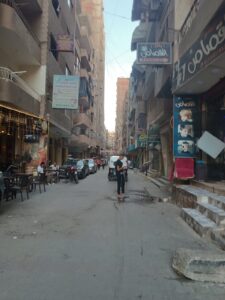
Shop-full streets in Faysal.
“Inventing income’’: brokering as a resource
Navigating within Faysal to secure sources of income also takes the form of brokering various activities. This means serving as an intermediary, from which one would benefit financially and gain social capital. These in-between facilitatory activities flourished due to the lack of formal employment opportunities in Egypt. Two types of brokering activities are particularly prevalent among Sudanese displaced in Faysal.
In the real estate domain, many Sudanese operate informally as “simsar’’, a term that literally means “intermediary”, but in the Egyptian context refers to agents in the housing market. Typically, a Sudanese or an Egyptian property owner circulates information within his network about an apartment available for rent or sale. A simsar – with an extended network and the owner’s trust – then coordinates with a network of brokers who connect potential tenants or buyers with the property. The profits of these transactions are shared throughout the network with those lower in the hierarchy receiving only a small portion. The widespread involvement of Sudanese in this activity is linked to the large numbers of displaced individuals in need of accommodation and other services in an unfamiliar context. Moreover, developments in the war in Sudan have had a direct impact on this market. For example, when the Rapid Support Forces (RSF) captured Wad Madani in December 2023, it triggered a massive influx of Sudanese in precarious conditions arriving through illegal routes and in urgent need of housing – often in Faysal where family networks exist. This surge not only increased the number of Sudanese simsars, but also drove up rent prices drastically, sometimes even doubling them within six months.
A second widely developed brokering activity is currency exchange combined with money transfers.[5] Many individuals, sometimes operating within shops, offer money transfer services between Egypt and Sudan via digital application linked to the Bank of Khartoum, which is widely used by Sudanese people. These transfers provide a source of income for the brokers and a critical lifeline for customers in light of the collapse of Sudan’s banking system and the widespread financial informality of Sudanese in Egypt. Beyond these financial benefits, these activities also serve as an important means of building social capital and earning recognition within the Sudanese community.
Navigating local power structures
Social navigation and economic survival strategies for the Sudanese in Faysal often involve interactions through local agents who act as intermediaries navigating different layers of authority, both formal and informal.
As Sudanese entrepreneurs are subject to frequent controls by government authorities such as registration checks, tax and revenue reviews, ensuring sanitary standards are maintained, and monitoring the origin of products, businesses utilize a number of mechanisms to address possible penalties. Business owners who are not able to meet requirements might delay fines and foreclosure by engaging in the widespread practice of (baksheesh), a common phenomenon among Sha’abi businesses.
Thus, there is a continuous process of negotiation and dialogue between Sudanese entrepreneurs, brokers and the agents who control the district, whether they are official of not. These interactions are often mediated through financial and social capital.
Conclusion
Within a rapidly shifting context and uncertain future, flexibility becomes a crucial survival strategy for Sudanese displaced in Egypt. As regulations, security conditions, and economic context transform quickly,[6] they continually adapt their practices of earning a living and navigating the challenging context as well as creating spaces for social interactions. Under conditions of forced displacement and economic duress, the market reconstitutes social relations by creating winners and losers. On the one hand, Sudanese with social connections or economic capital prior to the war were able to leverage these assets to gain financial benefits – such as in the real estate sector – and achieve social recognition. On the other hand, those lacking such resources often face disempowerment, impoverishment, and increased vulnerability. Consequently, a hierarchy of power emerges, shaped by pre- and existing networks and capital, and everyday market interactions. Moreover, the dense urban environment of Faysal, coupled with an authoritarian state which hardened its policy towards Sudanese nationals, compels them to adhere to implicit social rules and engage with a range of agents – official and unofficial. Forced to be extremely vigilant, they navigate a web of both formal and informal regulations, and multilayered forms of controls.
Endnotes
[1] Zanig is a music style of synth-driven music with techno-style repetition. This form of underground music became popular in 2010s, especially among young urban Sudanese and gradually acquired a political dimension, with lyrics critical of power and expressing a rejection of the dominant cultural norms imposed by the official arts and culture promoted by the state.
[2] This security check is neither mandatory for all foreign nationals nor for every type of company. It represents a recent extension of control measures aimed at regulating foreign investment and economic activity. For example, in 2017–18, it was applied only to certain sectors established by Syrians; after the outbreak of the war in Sudan in 2023, Sudanese investors initially did not face this requirement. Officially, the process is designed to ensure that new business owners are not engaging in money laundering – and, in the case of Syrians, to verify they have no ties to terrorist organizations.
[3] Amr Adly coined the term “baladi market”; see Amr Adly: Cleft Capitalism: The Social Origins of Failed Market Making in Egypt (Stanford, CA: Stanford University Press, 2020), 54.
[4] The closure of USAID at the beginning of 2025 seems to have had a major impact on these aid programmes.
[5] At the beginning of 2024, the surge in the price of foreign currencies (dollars and euros) led to the development of a large black market in Egypt in which numerous Sudanese brokers were involved.
[6] At the time of writing, the context in Sudan is changing rapidly. By March 2025, the armed forces had seized Khartoum and several other regions, a move that, while not ending the war, has profoundly affected Sudanese in Cairo. Since late March, large buses have been leaving Faysal each day, carrying hundreds of people back to Sudan, and some residents have even turned their businesses into ad hoc travel agencies to meet the demand (field observations, April–June 2025).
Debating Ideas reflects the values and editorial ethos of the African Arguments book series, publishing engaged, often radical, scholarship, original and activist writing from within the African continent and beyond. It offers debates and engagements, contexts and controversies, and reviews and responses flowing from the African Arguments books. It is edited and managed by the International African Institute, hosted at SOAS University of London, the owners of the book series of the same name.
The post Navigating an Uncertain Environment: Survival Activities of Displaced Sudanese in Egypt appeared first on African Arguments.